On a weekend of motel TV with no streaming, one commercial kept coming around. Two friends meet on the sidewalk, and one is showing off a shiny new smartwatch:

Friend: “Oh, hi, Sharon! You’ve got a new smartwatch! Did you get a raise?”

Sharon: “No, I just downloaded an app that pays me to play games on my phone!”

Cut to someone stretched out on a couch, beaming at her phone.

It sounded too good to be true. So I drew up my own version of how that story usually ends.
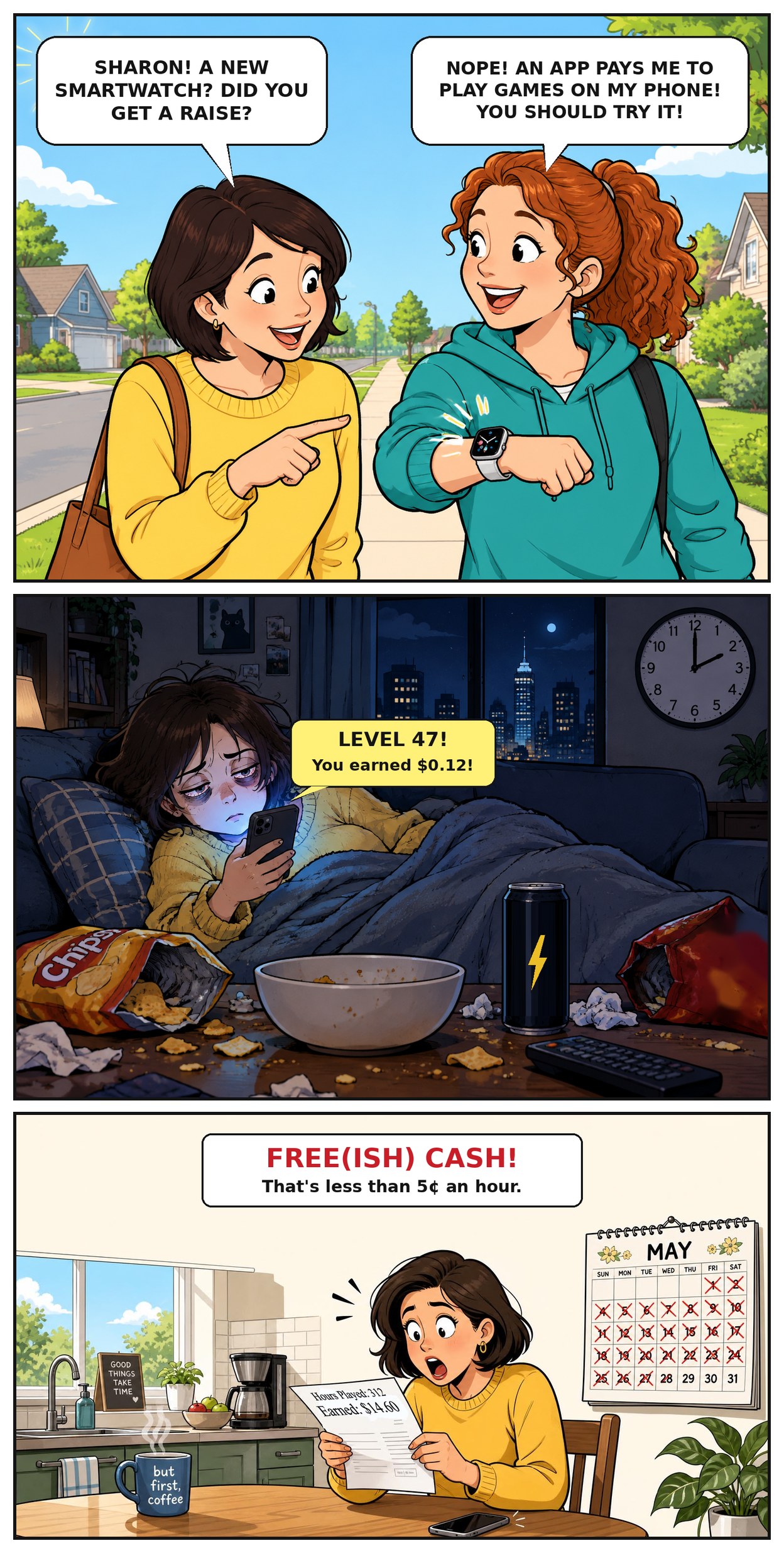
Three-panel cartoon. Panel 1: a woman in a yellow sweater asks her friend Sharon, who is showing off a new smartwatch, 'Did you get a raise?' Sharon answers, 'Nope! An app pays me to play games on my phone! You should try it!' Panel 2: at 2 a.m., the friend lies on her couch surrounded by empty snack bags, bleary-eyed, as her phone announces 'Level 47! You earned $0.12!' Panel 3: the next morning, she stares in shock at a statement reading 'Hours played: 312. Earned: $14.60.' Caption: 'Free(ish) Cash! That's less than 5 cents an hour.'

AI-generated cartoon panels, edited and lettered for this page.

How These Apps Actually Work

“Get paid to play” apps aren’t charities. Game companies pay them to deliver new players, and the app passes a slice of that money to you, but only after you reach certain levels in a game, usually before a deadline. The games are chosen because players like you tend to spend money inside them or watch paid ads. You’re not really being paid to have fun. You’re being paid to become someone else’s customer.

The real hourly rateReviewers estimate roughly $2 to $5 an hour, and most users earn $5 to $20 a week.
The big payoutsOffers of $300 or more exist, but they can take days of play and often require in-app purchases.
The adsSome promised “up to $35 an hour” for scrolling TikTok. TikTok said those ads broke its rules and pulled some of them.
Your dataEach game you install brings its own tracking and privacy policy. Security firm Malwarebytes put it this way: “your attention and data are the real products.”
In fairness: the cartoon exaggerates a bit. Less than a nickel an hour makes a better punch line than two or three dollars. And the best-known app, Freecash, does pay people; its parent company says it doesn’t sell user data. But even at the reviewers’ numbers, that’s far below minimum wage, and it costs you something that never comes back: your time.

If an app wants to pay you to stare at your phone, it’s worth asking who’s really getting the better deal. Usually it’s the folks selling the games, the ads, and the information about you.

Your time is worth more than Level 47.
Spend it like it.
Cartoon panels created with AI image tools and edited by Robert J. Burtis; research and page design with AI assistance, in keeping with my published AI Collaboration Manifesto.