Is Live Music Dead?
When fans pay for a choreographed, pre-engineered production masquerading as a concert, is it really live music?

Originally published by Daniel Van Auken on Medium. Subscribers may also read it here.

| Taylor Swift's Eras Tour grossed over a billion dollars. Meanwhile, pop stars like Charli XCX and Olivia Rodrigo, as well as legacy acts like The Eagles, KISS, and Motley Crue (to name a few), continue to sell out stadiums. Clearly, live performances aren't dead. But is live music? There's a crucial difference between a live performance and live music. More often than not, today's audiences aren't paying hundreds, if not thousands of dollars, for music performed actually live, in real time. They're paying to witness a spectacle: a choreographed, pre-engineered production masquerading as a concert. This blurring of lines isn't new. Live albums have been polished, overdubbed, and doctored for decades, to the point where, in any other industry, it might be considered false advertising. And now, much of what passes for a "live show" is no better. But do fans even care? More importantly, do the artists? Behind the Curtain: A Musician's Point of View After graduating from high school and having played clubs since I was 14, I toured professionally for years, performing everywhere from Vegas casinos and music festivals to corporate events, theaters, and everything in between. As a bassist and guitarist, and later a solo artist signed to UMG/Virgin and a Sony imprint, I opened for Grammy winners and big names across pop, rock, country, and even hip-hop, which was somewhat unexpected, considering my genre. |
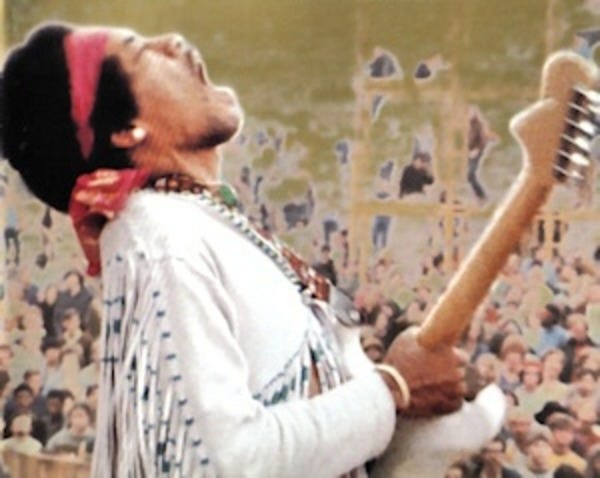 Jimi Hendrix live at Woodstock, 1969 | Source Wikipedia |
Here's what I saw throughout my decade playing professionally: not one artist I played with, opened for, or worked around used Auto-Tune or lip-synced to backing tracks (with the exception of a household name in hip-hop). Sure, pop acts have mimed along to the music for decades. And some groups, especially those unable to tour with full horn sections or an orchestra, used backing tracks to fill in the gaps. However, this wasn't hidden, nor was it the rule. It wasn't pervasive throughout the entire industry. The groups I played with had keyboards handling the string or horn parts if needed, and what was 'missing' musically, the audience didn't even notice. They were swept up in the energy of the live music. I played thousands of gigs and crossed paths with hundreds of musicians across nearly every genre. In the world I was part of, primarily the 2000s rock scene, it was all about being live. Full stop. At festivals, I often sat with the front-of-house engineers for both indie and major acts before or after my sets. I saw every unit in their racks. If there had been trickery, I would've seen it. I didn't. The same was true for the monitor engineers, stage techs, and backstage crew. No one was triggering parts offstage, and I never once saw a hidden guitarist or keyboardist literally behind the curtain, secretly 'enhancing' or covering for an inept player. When bands used prerecorded tracks, such as a pre-recorded loop or synth effect, they were still playing their instruments live. It was still a live concert. But things changed, and it's never been the same. Live Performance vs Live Music Popular music of all genres has always been more spectacle than sound. However, as technology became cheaper and easier to use and integrate into live settings, other genres followed. Now it's the norm. Entire sets are timed to the millisecond. Vocals are layered: the singer's mic is mixed low while the album or another prerecorded track created for the live show carries the melody. Auto-Tune runs constantly, or waits on standby just in case. Yet, it doesn't have to be this way. Technology has always been the primary driver of change in music, and when utilized creatively, it can heighten not only music but also live concerts. Radiohead's groundbreaking album Kid A, now 25 years old, forced the band to completely rethink how they performed live. To bring its digital soundscape to the stage, they didn't lean on backing tracks. Instead, they utilized a wide range of tech to create digital loops and effects, which became a fascinating part of the live performance itself. They could've taken the easy route and had Thom Yorke sing over pre-recorded tracks, but they didn't. They adapted as artists. And watching that evolution was exciting, not defeating. |
| Unfortunately, decades after Radiohead proved that complex, studio-crafted albums can be performed live, that level of authenticity has become increasingly rare. So much so that calling many modern concerts 'live' is, at best, misleading. And the issue isn't always a lack of musical talent; it's often a lack of willingness. Taylor Swift can clearly sing and play the guitar and piano. But like most pop stars, she isn't delivering a truly live concert experience. The reality is, she's putting on a performance. A performance no different than a Broadway production: polished, choreographed, and 100% controlled. Nothing is left to chance. And there's little, if any, spontaneity from one gig to the next. You learn your lines, hit your marks, and get paid. It's scripted entertainment, not a genuine musical experience. Why? Because in today's live music economy, risk is unacceptable. Promoters won't tolerate missed cues or, God forbid, a flat note. Every show must be pitch-perfect, night after night, to keep the 'dynamic ticket pricing' machine running. Although the pop world gets singled out the most for these live productions, it isn't alone. |
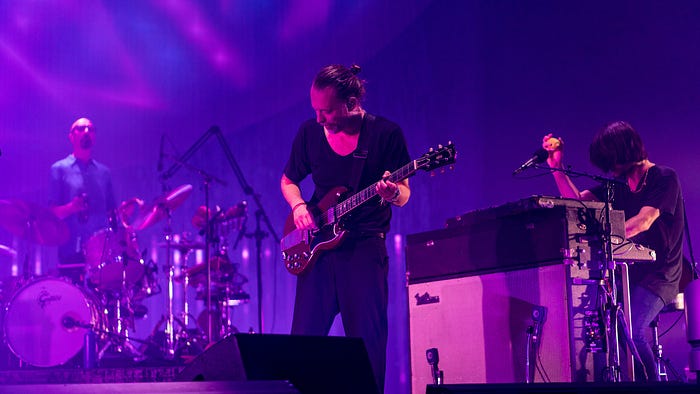 Radiohead live, 2018 | By Raph_PH, Source Wikipedia |
|
The Problem Isn't Just Pop The next time you think about going to see your favorite act from 30 or 40 years ago, think twice. Legacy rock acts are just as guilty, and to add insult to injury, far more hypocritical. Britney Spears never hid the fact that while dancing across the stage, she relied on canned vocals. To her credit, at least to some extent, even if only after the fact, she acknowledged using backing tracks for her vocals due to the challenge of performing complex choreography for an hour and a half. But when's the last time you saw The Eagles do a dance routine? The Eagles perform the same show every night. Don Henley currently lip-syncs most of his vocal parts (allegedly). KISS has used backing tracks for years (allegedly) and not just for the vocals but the guitars too (allegedly). Motley Crue? The bad boys of rock from the '80s are equally as guilty. Vince may sing live, but the music is 'canned'. These aging rock groups have become the most egregious offenders. They once mocked the pop world for its 'inauthenticity', yet they too employed the same tactics, and not just on the stage either. We've all heard the story: KISS's legendary Alive! album was essentially an in-studio recording with crowd noise overdubbed later. Honestly, I couldn't care less. KISS was always more image than substance. But it's worth repeating every chance we get, if only to keep Gene Simmons's ego somewhat in check. But set KISS and Gene Simmons aside, and consider musicians who are actually respected, like Eddie Van Halen. Van Halen's 1993 live album Live: Right Here, Right Now was anything but live. According to Sammy Hagar's autobiography and interviews, the original live recordings were scrapped, and the entire album was re-recorded in the studio. Fans paid $20 or more for a CD that was essentially a studio album disguised as a concert. Ultimately, this isn't just a pop problem or a rock problem; it's the loss of artistic integrity. Thankfully, not everyone has sold out to putting on a show consisting of smoke and mirrors. With Oasis's recent reunion tour, both Gallagher brothers, now in their 50s, are playing massive, fully live shows. No backing tracks. No Auto-Tune. No trickery. Just musicianship. And the audience can feel it, the music moves straight from the soul to the speakers. It's how it should be. Obviously, the artist does have a say in how they present their shows, well, at least to a certain extent. Who's Really to Blame & Does the Audience Care? The truth is, for most people, it's about the experience, the visuals, the pyrotechnics, the glitz and glamour, the thrill of seeing their idols in the flesh. It's not really about the music. And that's nothing new. The industry has always been 99% image and 1% substance. Need proof? Take a look at the current top ten on Spotify or traditional music charts. Not convinced? Go back 40 years, and generally, the top ten or twenty is filled with formulaic songwriting for the masses. This isn't meant as an indictment of the audience, but of an industry that has misled the public from the very beginning of popular music. In 1966, The Beatles stopped touring, not because they couldn't have continued to make millions, but because they couldn't hear the music over the fans screaming. Their shows quickly went from being concerts to a circus. Rather than fake it, they walked away from the stage. Today, such integrity is rare, but walking away from performing live isn't viable, because it's not just artists who have changed. The entire industry has undergone a transformation beyond recognition. Record sales have collapsed. Nobody buys music anymore. Labels, desperate for revenue, now push '360 deals, taking a cut of everything: tickets, merchandise, and even live performance earnings. Artists tour longer, harder, and lean more on technology to keep up. Human exhaustion is replaced with digital crutches to prop them up. And it's not just labels. Agents, promoters, and venues all squeeze the system dry. The result? Music becomes muzak. Art becomes a product. It's called the music business for a reason. There's Still Hope Ultimately, I don't entirely blame the artists. The pressure is immense, and technology, when used correctly, can enrich live music, as Radiohead has proven. Thankfully, many still deliver honest, powerful live performances every night. Oasis is back and sounding incredible. Additionally, Springsteen, Foo Fighters, Greta Van Fleet, Sturgill Simpson, and countless others worldwide, across all genres, continue to play live music (to name just a few). What hasn't changed is the greed and deception of the industry. It's called show business for a reason. But there's hope. As indie artists thrive online and record labels lose their grip, don't let the vapid top ten or scripted shows get you down. If there was ever a time for a music revolution, the time is now.
I encourage you to subscribe to "Medium" and to support the creativity and work of writers such as Daniel Van Auken and many other talented authors. |