
You'd be forgiven for thinking that I am an expert in philosophy. I am only a humble physicist. And while physics can instruct us on the merits of one philosophy over another, it cannot necessarily point us to the right one. It is rather the reverse. Every physicist, deep down, has a philosopher struggling to get out because, without philosophy, we are merely wranglers of equations, slingers of predictions, and collectors of measurement data. Without philosophy, physics is just shutting up and calculating.
Now, I love a good calculation, but at the end of the day, to understand what that calculation means, I need philosophy.
The philosophy I choose can have vast repercussions on how I interpret findings, what theories I find most appealing, and what direction I want my research to take.
In this way, physics is not that different from theology. But whereas theologians have great respect for philosophy, physicists have a tendency to treat it like a waste of time — this is even though all of the most fundamental concepts in physics: time, space, matter, causation, probability, measurement, observation, and even the concept that physics exists at all are based in philosophy.
For centuries, Western civilization has been based upon the philosophy of the Greeks: Plato and Aristotle. Medieval theology drew life from them. Concepts like substance, potential, essence, form, and ideals formed the backbone of how theologians understood God, the soul, heaven, hell, and humanity's place in the cosmos. Scientists, likewise, understood time, space, and matter similarly. Objects had substance and form. Even as Galileo and Newton swept aside Aristotle's physics, they kept his understanding of the universe as made up of objects that had essential natures, relating to one another through forces, all the while an impersonal, absolute time moves everything forward.
In fact, classical physics fits perfectly well into this philosophical framework. As theology marched forward with Calvin and his double predestination — where an absolutely sovereign God chooses who goes to heaven and who goes to hell — Laplace argued that because all the laws of physics are deterministic, the future is likewise determined, and one could, with perfect knowledge, predict all future outcomes.
All this was to come crashing down with the invention of quantum mechanics. Suddenly, it became clear that what underlaid the foundations of the cosmos was not necessarily order and clear direction but indeterminism. Suddenly, physics needed a new philosophy.
Niels Bohr, one of the fathers of quantum mechanics, was deeply fond of the philosophy of Kant. Kant argued against the idea that we could ever really know things in themselves. Therefore, Bohr believed that quantum theory was just a representation of how particles interacted with measuring apparatus — purely symbolic but useful.
Others, like Heisenberg, wanted to reapply Aristotle, arguing that wavefunctions were similar to Aristotelian potentiality. Aristotle had this idea about potential things transmuting into actual things, and to Heisenberg, this was very similar to what was happening in quantum mechanics. A wavefunction represented potential things, and when a measurement was made that potentiality was converted into actual reality. When the wavefunction has not yet been measured, the particle does not exist — it only potentially exists.
Analogy
This is not unlike a young person growing up. They are full of potential; no one knows what they are going to be. As they grow, they become more and more actualized, and that potential becomes reality.
Albert Einstein opposed the interpretations that Bohr and Heisenberg were proposing. He believed that quantum mechanics was fundamentally incomplete and that a truer theory would be discovered that would accord better with how he viewed the universe. Einstein saw the universe as largely fixed, like a book that had already been written — we just happened to be reading it one page at a time. Einstein's concept of God was as a Being who had written this book, including all the laws governing its pages. This is not that different from the timeless, changeless God of the Roman philosopher Boethius and Saint Thomas Aquinas, who stood outside time, watching all of history simultaneously. This God never changed His immutable mind. In Aristotelian terms, God cannot have potential — He is entirely actualized.
Life would be simple if quantum mechanics were all we had to contend with. But quantum mechanics is merely a special case of quantum field theory. In quantum field theory, the particles so important to quantum mechanics are mere excitations of the field, like a toddler jumping on a springy bed — here today and gone in the blink of an eye. The particle is like the actualization of the field, but the field is not nothing either. Fields have many, many particle interactions inside them, most of which are virtual, meaning that the particles aren't quite real — yet they still have a measurable effect.
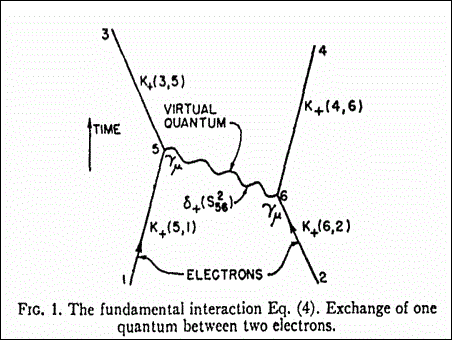
In 1948, a way of understanding field theory was introduced by a Ph.D. student who had suspended his studies during WWII to help with the Manhattan Project. He wanted to turn field theory, which was very abstract at the time, into something more tangible — more like classical physics, where you could picture what was going on.
His solution was to turn those summations into diagrams that picture what's going on in the field theory — the sort of thing that might happen in a particle accelerator or even a nuclear explosion.
Here are three more examples of these diagrams, all depicting Compton scattering:
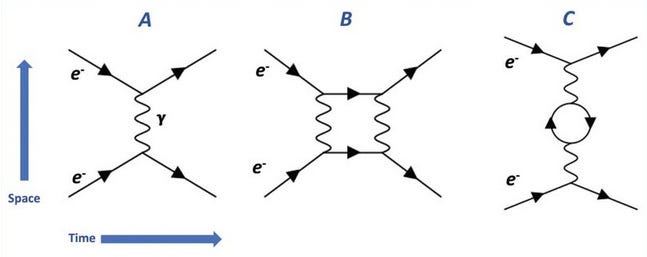
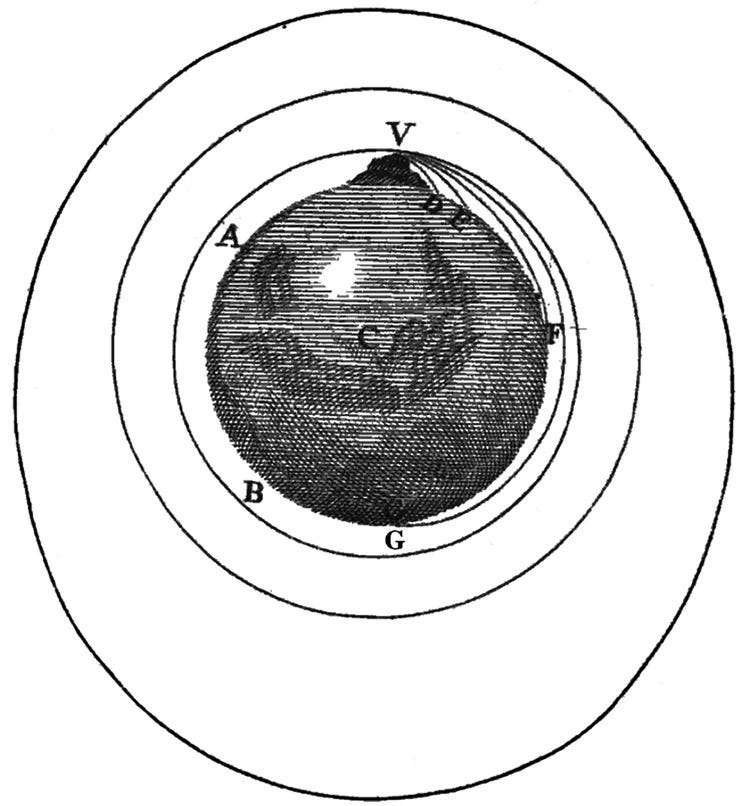
What's interesting about these diagrams is that all the external lines are the same, yet each diagram is different. Unlike the diagram for the trajectory of a cannonball, they don't go anywhere specific or come from anywhere we care about. Like subway maps, these diagrams don't necessarily tell you anything about where particles go in physical space and time. What they do tell you is the stops they make along the way — what happened.
In this sense, these diagrams do not describe objects because objects are not stable in field theory. They transmute into other things and back again. Instead, they describe events. They tell you what happened.
That Ph.D. student, whose name was Richard Feynman, went on to make many more discoveries, but perhaps none so philosophically profound as this pictorial way of representing what field theory represents: the primacy of events over objects.
Key Insight
Events are part of the fabric of spacetime in a way objects aren't. Events are what happen, while objects are impermanent and in flux. We never see the lines in the diagrams — we only see the vertices.
A philosophy that better represents field theory is not one of potential and actualization of things, but one where events are the primary content of the universe, and objects are merely strings of such events that maintain some similarity to one another. Process philosophers such as Alfred North Whitehead argue that this is a better way of understanding the world and, indeed, God as well.
In his book Process and Reality, Whitehead argues that the universe is made up of events called actual occasions — momentary events of becoming. Thus, all things are always becoming, not being, even you and me. Every event integrates influences from the past and actualizes one of many possibilities. Each of these events is an example of the universe experiencing itself and producing novelty. For Whitehead, the future has not been written yet, and we are the genuine authors of our own experience.
Whitehead's slogan was that the world was composed of "drops of experience" — a position known as panexperientialism. All matter is capable of some kind of experience, even atoms. Thus, atoms and we are not beings but becoming as patterns of experience, and if field theory is any guide, this might fit best with modern physics.
Essential to process philosophy is this concept of events which turn possibility into actuality. In the case of human beings, we call this free will. Reality is indeterminate. The future is being written by matter all the way from electrons up to human beings and beyond.
A theory called the Ghirardi-Rimini-Weber (GRW) theory proposes a physical process by which wavefunctions spontaneously collapse, especially when interacting with macroscopic systems. One formulation, developed by Roderich Tumulka and others, explains this in terms of flash ontology: fundamental entities in the universe are "flashes," each one an event in space and time. Reality is a network of these flashes all connected, and what we think of as matter is simply patterns of flashes — like dashes and dots over a telegraph wire. In a Whiteheadian metaphysics, each flash contains experience and creative self-determination. The flashes are not merely collapsing wavefunctions but reality inventing itself to experience itself.
John B. Cobb Jr. extended Whitehead's metaphysics into process theology, where God does not control events deterministically. Rather, God offers possibilities or "lures" toward greater value. Human beings have free will to either move toward these lures or away from them through the self-determining nature of events. Each event inherits influences from its past, considers available possibilities, and determines its own final form.
Thus, human free will is not an exception to the determinism of nature but a higher form of the same freedom that all matter enjoys.
Unlike in classical theology, God in process theology is seen as actively participating in the universe's unfolding. Divine power does not determine outcomes but rather persuades. God's purpose for the universe is emergent rather than imposed.
According to Cobb, God is dipolar, having a primordial pole that generates the possibilities of the universe and a consequent pole that allows him to experience the world along with us. The future is genuinely open, and God may change with the world.
Ancient and medieval theologians, steeped in Plato and Aristotle, believed that God had to be unchanging (immutable) and unaffected by emotions (impassible) as well as outside of time (timeless) because otherwise, if he could change or be affected in any way, he would be less than perfect. In fact, these ideas come straight from the pagan Greeks rather than from any Biblical doctrine.
Process Theology's Critique of Classical Theism
Process theologians point to many instances in the Bible where God changes his mind or expresses emotion (e.g., Genesis 6:6, Exodus 32:11). For process philosophy, all things are becoming, and thus, to be perfect, a being must become perfectly. This is God's nature: God relates to all creation perfectly by responding to all creation perfectly. God truly suffers, shares in the consequences of human actions, and works persuasively toward his greater good. He has the greatest possible capacity for relationships.
Some process theologians like Cobb steer clear of making definite statements about the nature of Jesus Christ. Although they reject Aristotelian concepts of substance — which makes the Trinity or the nature of Christ difficult to support in its classic form — they seem influenced by modernist, liberal theologies in downplaying the true nature of Christ as divine and of his resurrection as a genuine miracle, instead drawing "meaning" from these stories symbolically.
None of this is necessarily a consequence of process philosophy itself, but rather a direction that these theologians have chosen. Other process theologians, however, like David Ray Griffin, have argued that miracles are entirely consistent with process philosophy and argued for the resurrection as a genuine event, while Marjorie Suchocki has argued for the real divine presence in Jesus and not merely a symbolic presence.
Fundamentally, the Trinity must be interpreted relationally, as love shared in the midst of God. Christ's nature flows from that relationship as the second person of the Trinity. C. S. Lewis offers this insight on miracles:
It is therefore inaccurate to define a miracle as something that breaks the laws of Nature. It doesn't... If God annihilates or creates or deflects a unit of matter He has created a new situation at that point. Immediately all Nature domiciles this new situation, makes it at home in her realm, adapts all other events to it.
C. S. Lewis, Miracles, p. 94
Thus, miracles are part of God's own creative freedom. Any moment allows for the possibility of a miracle, even ones as shocking as the incarnation and the resurrection.
As we discover more about the universe, it seems increasingly clear that change is the only constant. Quantum field theory and quantum mechanics, in general, suggest that events that actualize possibilities into reality are a natural way to understand the universe. Will our understanding of God keep up or remain in the Middle Ages? It seems that we have a difficult tightrope to walk between updating our philosophy without throwing out everything in favor of a lukewarm scientism.