A Dialogue
A friend I respect highly and I chose to discuss the issues surrounding the arrival ICE agents into Minneapolis and their efforts to locate, arrest and deport illegal immigrants. The focus is supposed to be on known and wanted criminals, but certain elements of the liberal Twin Cities community march, protest and attempt to threaten and intimidate federal agents assigned to this task. My friend begins by stating:
Thank you for taking the time to send over your thoughts regarding these frightening events and this difficult time. I'll do my best to reciprocate with the same thoughtfulness, compassion, and sensitivity as you have done in your email. And I won't include any Gutfield videos or links to right wing YouTube videos, although I will include a few reels from the MRC and links to a couple YouTube news reports. I've also done extensive research on ChatGTP and Perplexity AI. And I am nothing but honored and proud to have raised a friend who cares as much as you do about your family, your community and your country. These are complex issues with no clear cut solutions, but I respect you too much to simply toss around some quick thoughts. And I've had 74 years to live through, think about, and consider these problems based upon personal experiences, educational background, extensive reading, study and research, as well as deep-seated lifelong spiritual perspectives. As I approach the end of my time on this planet, it becomes even more important than ever to me that I try and exert a constructive and positive common sense influence upon my family, friends and society, which is much of the reasoning behind my vanity website project, which I fully realize is viewed by very few and taken seriously by even fewer - and yet, I still believe it is a worthwhile effort, and my intentions are sincere. I spent a lot of time viewing all of the videos you suggested I take a look at and reading through the links you provided, so I could fully understand your perspective. I respect you enough to believe that you are willing and able to see different perspectives and consider opposing points of view - as am I! I think it is also necessary and helpful to look into the history of our country's problems with illegal immigration, and I present this information - not to prove anything - but to have a legitimate and accurate historical perspective. Bill Clinton said in a speech that: "We are a nation of immigrants," Clinton said. "But we are also a nation of laws. It is wrong and ultimately self-defeating for a nation of immigrants to permit the kind of abuse of our immigration laws we have seen in recent years, and we must do more to stop it." Our immigration policy is focused in four areas: first, strengthening border control; second, protecting American jobs by enforcing laws against illegal immigrants at the workplace; third, deporting criminal and deportable aliens; fourth, giving assistance to States who need it and denying illegal aliens benefits for public services or welfare. Our plan will triple the number of criminal and other deportable aliens deported since 1993. We want to focus on the criminal population or on those who are charged with crimes but who are here illegally. Every day, illegal aliens show up in court who are charged. Some are guilty, and surely, some are innocent. Some go to jail, and some don't. But they're all illegal aliens, and whether they're innocent or guilty of the crime they're charged with in court, they're still here illegally and they should be sent out of the country." While Obama was president, he said: "We simply cannot allow people to pour into the United States undetected, undocumented, unchecked, and circumventing the line of people who are waiting patiently, diligently, and lawfully to become immigrants in this country. Even as we are a nation of immigrants, we’re also a nation of laws. Undocumented workers broke our immigration laws, and I believe that they must be held accountable -– especially those who may be dangerous. That’s why, over the past six years, deportations of criminals are up 80 percent. And that’s why we’re going to keep focusing enforcement resources on actual threats to our security. Felons, not families. Criminals, not children. Gang members, not a mom who’s working hard to provide for her kids. We’ll prioritize, just like law enforcement does every day. But even as we focus on deporting criminals, the fact is, millions of immigrants in every state, of every race and nationality still live here illegally." |
|
You and your publication "Tangle" continue to be the voice of reason, moderation and sanity on the Internet and I have convinced several of my friends and family to subscribe and support your efforts. I have done some research of my own into the issues surrounding the war in Ukraine that I have not seen you discuss and I think it is extremely important that these historical facts be addressed publicly. I wrote this as an introduction to my own list of subscribers: A historical look at the relations between the United States, Russia and Ukraine, called "The Ukrainian Crisis - It's Not All Putin's Fault". I am 100% a patriotic American guy, but I also think it's important to see both sides of any story and there is an aspect to these vitally important issues that you won't see discussed anywhere else. I would appreciate it if you would review what I have published and present anything you find useful to your readers, as well! With deep respect and appreciation for all you do. |
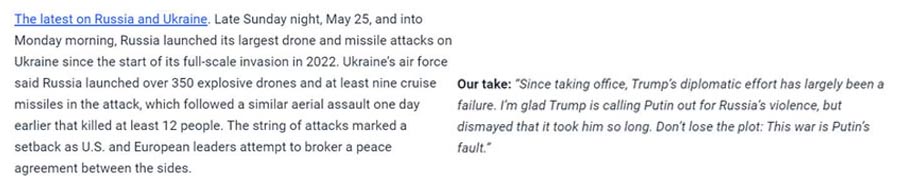
| A week later, Tangle published another article on this topic, summarized by these remarks: |
 |
Which inspired me to write again: |
| There is no doubt that Russia is the aggressor in this war, while the United States and European countries continue to fuel the confrontation by providing weapons and funds to Ukraine. As an American patriot and a supporter of the right of Ukraine to remain an independent country, I am of the opinion that an end to the war will not be possible until the United States and the world at large recognizes and acknowledges the role which the U.S. and NATO has played in provoking Russia into taking the actions it has on the world stage. Obviously, "This war is Russia's fault", as you say, but the policies of the United States government over the past 15 years have brought us to where we are today, and created a new Cold War which threatens an escalation that could have disastrous consequences. In line with Tangle's desire to seek and present a balanced overview of important issues, I would appreciate it if someone on your staff would dig deeper into the history of this confrontation and try to present BOTH sides of the story. |
I realize there are many important topics and issues that Tangle must attempt to deal with and every day seems to present another threat or tragedy which makes headlines across the U.S. But now you folks are talking about WWIII! "...one truth has remained: The man behind the threat of World War III - the one whose reaction everyone is so worried about - is Vladimir Putin." "Putin is the one who invaded Ukraine. He is the one who can leave Ukraine. He is the one who believes Ukraine rightfully belongs to Russia, and he is the one who can end the war any day." "He has long been committed to destabilizing NATO and the EU." "I'm the last person in the world who wants to see more war. But there already is a war. Putin started it. I am insisting that the world (especially Americans) look at what is happening in Europe with clear eyes. This has been the plot from the very beginning." Where is the other side of this argument? Tangle is supposed to see all sides and debate the merits of each point of view. America and NATO are the good guys and Putin is one bad dude - AGREED! But the recent history of NATO seems to demonstrate a strategy of encroachment and an attempt to surround Russia with NATO countries, NATO armies, and NATO nuclear weapons. And if we are approaching WWIII, shouldn't we look at both sides of this issue? Reagan and Gorbachev established a "detente", Nixon and Brezhnev signed SALT agreements. Then the U.S. government and NATO members began expanding into former Soviet bloc countries. Putin is certainly the bad guy in all this, but what role does the U.S. and NATO play in boxing Russia into a corner and threatening its very existence? |
I was excited when Tangle's founder, Isaac Saul, wrote back! |
| Sorry for not replying earlier. I had followed the link. A few things: 1) We have definitely shared a version of this perspective before in Tangle, and will continue to (we actually have a lengthy podcast interview coming out soon with Richard Sakwa) 2) I don't really understand your argument here, if I'm honest. What is the "new kind of terrorism" that is threatening the world? You never explain or elaborate, so I have no idea what you are talking about. 3) NATO "encroachment" as a framework here is bizarre; you talk about it as if the United States compelled these countries into the NATO orbit, rather than Russia compelling them. These nations were moved to join NATO not just because the U.S. and Europe wanted them, but because they wanted protection from Russia. And Putin's invasion of Ukraine proves exactly why that protection was wise. I don't really see how anything you lay out here undermines that argument. |
And I replied, saying: |
| Thank you for replying. I don't mean to be a pain in the ass about this, but when Tangle begins saying stuff like: "The man behind the threat of World War III is Vladimir Putin." It's hard to believe you actually read the article I posted or watched any part of the four minute video from another expert that I included. What is the "new kind of terrorism" that is threatening the world? "Whichever existential or grave world threat you might emphasize, and for some people, it's climate change. For some people, it's human rights. For some people, it's a spread of democracy. For me, it has been for quite a while, the new kind of terrorism that afflicts the world. It's no longer these so-called non-state actors. These guys are organized, they have an army, they have a self-professed state and they have a capacity to harm us gravely." "This is the real threat today. This kind of threat cannot be even marginally diminished. And I'm not sure we can ever end it in our lifetime, unless we have a partner in the Kremlin. That's the long and the short of it. What we need are these common interests in a partnership. The way two business people make a contract. They've got the same interests. They trust each other because if one side violates the interest, the other guy's interest is violated. We haven't had that. We don't have it today. The chance for a durable Washington, Moscow strategic partnership was lost in 1991 after the Soviet Union ended." "Actually, it was lost earlier because it was Reagan and Gorbachev who gave us the opportunity, but it certainly ended in the Clinton administration and it didn't end in Moscow. It ended in Washington. It was squandered and lost in Washington. And it was lost so badly, that today we have been in literally a new Cold War with Russia. It's a really horrible situation and exceedingly dangerous." "The reality is, for whatever reasons the Clinton administration adopted in the 1990s, a Winner-Take-All policy toward Russia, they said we won the Cold War. But the four policies that most offended Russia and offended them today were the following. The decision to expand NATO right to Russia's borders. I mean, it's a joke. We say Putin has violated the post-Cold War order of Europe. Russia was excluded from the post-Cold War Order of Europe by NATO's expansion. Russia kept saying, "Hey, let's do a pan-European security arrangement like Gorbachev and Reagan said." I doubt that even President Trump fully understands the politics and the history behind these issues. When the Soviet Union collapsed, U.S. politicians decided the heck with the SALT treaties, detente, and working WITH Russia on the larger issues before us (such as a potential WWIII that is bandied about so often these days it almost seems inevitable). "There's the absolute refusal on the part of the United States to negotiate on missile defense. Missile defense is now a NATO project that means missile defense, building installations, whether it's on land or sea, is now part of NATO expansion, encirclement of Russia. It's part of the same system. Russians are absolutely convinced it's targeted at their nuclear retaliatory capability." Please watch the short video, if you haven't already. I make NO excuses for Putin and the hell he has created in Ukraine and the many thousands of Russian lives he has sacrificed and national treasure he has wasted so far. But I am old enough to remember a feeling of hope for the future when Gorbochav walked down a St. Paul street in June of 1990. Russia may truly be the "Evil Empire" and cannot be trusted - but the current conflict surrounding Ukraine and the very real risk of WWIII is - to a great extent - a result of political decisions made by the United States government and NATO allies over the past 20+ years. I sure don't trust Putin - but I also do not trust OUR government to act in the best interests of our global community. |
This was followed a few days later with a new article featuring exclusive interviews with Anne Applebaum and Richard Sakwa , representing two different perspectives on these issues, which is something Tangle does so well. Isaac wrote: |
| Robert, I'm surprised you didn't find Richard's perspectives interesting or compelling. I feel like there is a lot of overlap in his view and yours, no? Best, |
|
I was very interested in reading the two exclusive interviews featured in the October 17th edition of Tangle. And equally disappointed with the content. Dueling perspectives on the Ukraine-Russia War I've been honored and impressed by the time you have personally invested in replying to my emails and point of view. You sure have no obligation to correspond with a 73 year old rock & roll musician in flyover country about United States foreign policy. And why should you? You and your staff are affiliated with and plugged into national and international news media and political operatives in both parties. And yet, that IS the appeal of and the essence of Tangle, as I understand it - not relying on legacy media and entrenched politicians or political party hacks along with "gotcha" journalists and influencers, but reaching out for answers and dialogue from anyone and everyone in search of common ground and an understanding of issues from all sides. In my previous email on this topic, I had hoped you would at least be willing to approach and consider what I see as the "elephant in the room" regarding relations between the United States, Russia, NATO, and Ukraine. A possible descent into WWIII is something I would hope we would all like to avoid! Ronald Reagan originally referred to the Soviet Union as the "Evil Empire". "Reagan relaxed his aggressive rhetoric toward the Soviet Union after Gorbachev became General Secretary of the Soviet Politburo in 1985, and took on a position of negotiating. In turn, the Soviets reversed their hostile view of Reagan and began negotiating in earnest. Reagan came quickly to recognize that Gorbachev's goals, far from being traditional, were downright revolutionary. He also saw that the transformation Gorbachev had in mind for his country would, if it came about, serve American interests. As a result, without much fuss and without many of his supporters noticing, Reagan underwent a transformation of his own. The fire-breathing cold warrior set about trying, through intense, sustained personal engagement, to convince Gorbachev that the United States would not make him sorry for the course he had chosen." Reagan and Gorbachev: Shutting the Cold War Down We heard talk about detente: "The main terms of the detente era were the easing of tensions between the United States and the Soviet Union, characterized by diplomatic negotiations, arms control agreements, and increased communication, particularly in the 1970s." And President Reagan stated his goal was: "...to keep America strong and free, while we negotiate real and verifiable reductions in the world's nuclear arsenals and one day, with God's help, their total elimination." I lived through the Cuban Missile Crisis and realized how close we came to experiencing MAD first hand. It's critical to understand the motivations behind Khrushchev and the Soviet Union's decision to secretly install both defensive and offensive nuclear missiles in Cuba in the early '60s. "The U.S. tried to get rid of Castro, first by funding and organizing a military intervention of Cuban exiles in 1960 called the "Bay of Pigs Invasion." Despite its bloody failure, the CIA repeatedly tried to overthrow or eliminate Castro, and the Department of Defense made plans to invade Cuba, calling for an invasion force nearly 100 times larger than the Bay of Pigs." Khrushchev felt he had good reasons for parking weapons of mass destruction in Cuba. First, he was certain a U.S. invasion of Cuba was imminent and wanted to protect the island. He was also frustrated that the previous year, the U.S. had placed nuclear missiles in Turkey, on the border of the Soviet Union. These missiles could have delivered a nuclear warhead to many strategic targets in Soviet territory, including Moscow. Khruschev argued that his intention for putting similar missiles in Cuba was to give the United States "a little of their own medicine." Reagan wanted threats of nuclear war to lead the U.S. and Russia away from confrontations and war via communications, negotiations, treaties, and arms reductions, through the Strategic Arms Limitation Treaty (SALT I) and the Helsinki Accords. Unfortunately- Cohen: "The chance for a durable Washington, Moscow strategic partnership was lost in 1991 after the Soviet Union ended. Actually, it was lost earlier because it was Reagan and Gorbachev who gave us the opportunity, but it certainly ended in the Clinton administration and it didn't end in Moscow. It ended in Washington. It was squandered and lost in Washington. And it was lost so badly, that today we have been in literally a new Cold War with Russia. It's a really horrible situation and exceedingly dangerous." Tucker Carlson was excoriated for his long interview with Vladimir Putin because he avoided confrontations and arguments. And yet, I thought it was a fascinating discussion which revealed a lot about Putin's beliefs and motivations. At the very least, here was a man with a deep and expansive knowledge about and personal interest in Russian history and international politics. Right or wrong, his thoughts and opinions are never shallow or contrived. For four years America was led by a senile old man obviously suffering from dementia who could barely walk four feet across a stage without falling over or manage a 10 minute press conference while muttering nonsense and then being quickly led away from the lectern by handlers. Was Putin simply spewing political propaganda hoping to impress Carlson and the American public? Probably - but he was cognizant, intelligent, informed and persuasive with a point of view that was buttressed by a deep knowledge and understanding of Russian history and contemporary international politics. And nothing excuses the crimes and atrocities being committed each and every day in Ukraine by the Russian military and its leaders. But perhaps - if we listened to one another and discussed our different points of view and political objectives - we could find some common ground and untangle the "tangle" without first sending submarines, aircraft carriers, and B2 bombers all armed to the teeth with MIRVed nuclear missiles to surround Russia throughout western Europe. Cohen: "This new Cold War has all the potential to be even more dangerous than the preceding 40 year Cold War." "You'll remember that after the Cuban Missile Crisis, Moscow and Washington developed certain rules of mutual conduct. They saw how dangerous, how close we came to nuclear war. There are no red lines today. One of the things that Putin and his predecessor, Medvedev, keep saying to Washington, "You're crossing our red lines." And Washington says, "There are no red lines! You don't have any red lines. We have red lines." I mean, "You can't have a military base in Canada or Mexico, but we can have all we want around your borders." Now, the position of the American political media establishment is that this new Cold War is all Putin's fault. War is all Putin's fault. All of it, everything. We did nothing wrong. At every stage, we were virtuous and wise, and he was aggressive. And a bad man." From the Tucker Carlson interview: Putin:"Russia even agreed voluntarily and proactively to the collapse of the Soviet Union and believed that this would be understood by the so-called "Civilized West" as an invitation for cooperation and associateship. That is what Russia was expecting, both from the United States and the so-called Collective West as a whole." "After 1991, when Russia expected that it would be welcomed into the brotherly family of civilized nations, nothing like this happened. You tricked us. I don't mean you personally when I say you, of course. I'm talking about the United States. The promise was that NATO would not expand eastward, but it happened five times. There were five waves of expansion. We tolerated all that. We were trying to persuade them. We were saying, please don't, we are as bourgeois now as you are. We are a market economy, and there's no Communist party power. Let's negotiate." Tucker Carlson Interviews Vladimir Putin Transcript "The reality is, for whatever reasons the Clinton administration adopted in the 1990s, a Winner-Take-All policy toward Russia, they said we won the Cold War. But the four policies that most offended Russia and offend them today were the following. The decision to expand NATO right to Russia's borders. I mean, it's a joke. We say Putin has violated the post-Cold War order of Europe. Russia was excluded from the post-Cold War Order of Europe by NATO's expansion. Russia kept saying, "Hey, let's do a pan-European security arrangement like Gorbachev and Reagan said." And we said, "This is not military. This is about democracy and free trade and it's going to be great for you. Swallow your poison with a smile." And while they had no choice, they did, and then when they had a choice, not - they start pushing back. Secondly, there's the absolute refusal on the part of the United States to negotiate on missile defense. Missile defense is now a NATO project that means missile defense, building installations, whether it's on land or sea, is now part of NATO expansion, encirclement of Russia. It's part of the same system. Russians are absolutely convinced it's targeted at their nuclear retaliatory capability. The reality is that the Pro Cold War forces in Washington in particular, who control the New York Times, The Washington Post, all the main broadcast and cable television networks, NPR and PBS are so powerful that it is a shock when a dissenting voice has gotten on their pages or on their air." What this all begins to look like - from my perspective - is a takeover of U.S. foreign policy by the military-industrial complex which is promoting weapons, missiles, tanks, warships, bombers and submarines and a policy of confrontation that puts all of us at risk for a real WWIII. Putin: "Moreover, I have also said this publicly before, there was a moment when a certain rift started growing between us. Before that, Yeltsin came to the United States. Remember, he spoke in Congress and said the good words, "God bless America." Everything he said were signals. "Let us in." There were smart people, including in Germany, Egon Barr, a major politician of the Social Democratic Party who insisted in his personal conversations with the Soviet leadership on the brink of the collapse of the Soviet Union, that a new security system should be established in Europe. Help should be given to unify Germany, but a new system should be also established to include the United States, Canada, Russia, and other central European countries, but NATO needs not to expand. That's what he said. If NATO expands, everything would be just the same as during the Cold War, only closer to Russia's borders. I became president in 2000. I thought, okay, the Yugoslav issue is over, but we should try to restore relations. Let's reopen the door that Russia had tried to go through, and moreover, I said it publicly. I can't reiterate. At a meeting here in the Kremlin with the outgoing president, Bill Clinton, right here in the next room I said to him, I asked him, Bill, do you think if Russia asked to join NATO, do you think it would happen? Suddenly he said, you know, it's interesting. I think so. But in the evening when we met for dinner, he said, you know, I've talked to my team. No, it's not possible now." Tucker Carlson: Were you sincere? Would you have joined NATO? Putin: We just realized we weren't welcome there. That's all. Okay, fine. But let's build relations in another manner. Let's work for common ground elsewhere. Why we received such a negative response you should ask your leaders. I can only guess why. Nevertheless, after that we tried to build relations in different ways. For example, the events in the Middle East in Iraq. We were building relations with the United States in a very soft, prudent, cautious manner. When I was in the USA at the invitation of Bush Senior. It is even easier to learn from someone I'm going to tell you about. I said, "Just imagine if we could tackle such a global strategic security challenge together? The world will change. We'll probably have disputes, probably economic and even political ones, but we could drastically change the situation in the world." He says, "Yes." And asks, "Are you serious?" I said, "Of course." "We need to think about it." I'm told. I said, "Go ahead, please." Then Secretary of Defense Gates, former director of CIA, and Secretary of State Rice came in here, in this cabinet, right here at this table. They sat on this table, me, the foreign minister, the Russian defense minister on that side. They said to me, "Yes, we have thought about it. We agree." I said, "Thank God, great. But with some exceptions." Now, about NATO's expansion to the east. Well, we were promised no NATO to the east, not an inch to the east, as we were told, and then what? They said, "Well, it's not enshrined on paper, so we'll expand." So there were five waves of expansion, the Baltic states, the whole of Eastern Europe, and so on."  There is SO much more information within that interview - and I won't keep posting excerpts - but if you look at what Putin is saying and what politicians and pundits in the United States are telling us, I gotta say - Vladimir Putin sounds much more reasonable and understanding of the political and military aspects of the decisions being made with regards to Russia, Ukraine and NATO. Mr. Sakwa seems to agree with some of the history here: Sakwa: "After the end of the Cold War in 1989-91, the United States insisted on maintaining its hegemony, its dominance, and that precluded allowing Europe to become more autonomous and, indeed, to allow Germany and Russia to come together with France and the other countries. That couldn't be allowed. NATO is a dysfunctional organization internally and catastrophic for Europe and global politics internationally. Absolutely catastrophic. It keeps boasting with its 32 members, the most successful military organization in history. It basically exists to sustain its own existence, and therefore to do that it has to foster and generate conflict. So you could say it's the most disastrous military alliance in history." "Biden had absolutely no contact with Moscow after the war began. And even the contacts before that were rather - well, I'd say confused and really not diplomatic, they just consisted of a series of threats." Ms. Applebaum sees thing a little differently: Applebaum: "Of course they hope that the U.S. will help them - and there has been, by the way, talk of the U.S. giving them some more long-range weapons that will make their campaign against the Russian oil industry go faster. And that would be great, and everybody would be happy. But no one is counting on it." Sakwa: "Can Ukraine withstand if you just give it more weapons, pile on the sanctions to Russia, cut its oil revenues and so on, then we will force Russia to the negotiating table? No. I don't think that argument really stands up. And Russia's strategy - and this is why it's been moving very slowly - has been not to gain territory in a spectacular manner, but basically to destroy the Ukrainian manpower and armed forces. And in that, they are winning in the sense that they've achieved their goal. Ukraine is demographically depleted, an economic basket case. Zelensky is increasingly unpopular. The population are demanding more and more now - a negotiated end, even if it means giving up some territory." Applebaum: "Listen to what Putin says. He has never said he wants to end the war. Listen for him to start talking about ending the war. And once he does it seriously, then we'll know we're in a new phase." Putin: "Wouldn't it be better to negotiate with Russia, make an agreement already understanding the situation that is developing today, realizing that Russia will fight for its interest to the end and realizing this, actually return to common sense, start respecting our country and its interests and look for certain solutions. It seems to me that this is much smarter and more rational. The world should be a single whole. Security should be shared rather than meant for the golden billion. That is the only scenario where the world could be stable, sustainable, and predictable." And this brings us back to previous comments from Stephen S. Cohen: Cohen: "This is the real threat today. This kind of threat cannot be even marginally diminished. And I'm not sure we can ever end it in our lifetime, unless we have a partner in the Kremlin. That's the long and the short of it. What we need are these common interests in a partnership. The way two business people make a contract. They've got the same interests. They trust each other because if one side violates the interest, the other guy's interest is violated. We haven't had that. We don't have it today." In closing this too long email, let me emphasize I am no hippie holdover from the '60s whining about the "military industrial complex". We must have a strong military and we always need to negotiate from a position of strength, backed up by powerful military weapons and overwhelming force. That was the Reagan strategy, as well, and it led to better relations with the Soviet Union, arms reductions, detente and a safer world. But after Reagan, politicians charted a course for world dominance, "winner take all", NATO expansion, and the absolute isolation of Russia. I wonder what The United States would do if these roles were somehow reversed? Tangle has the format, the people, the resources and credibility to take a deep dive into the history of the United States and our relations between Russia, NATO and Ukraine on the world stage. Please keep doing the important work Tangle is doing in trying to promote all sides of these issues and to find sanity and common ground which might lead to a safer and more productive world. |
My final email to Isaac regarding these issues said: |
| I read through all of the comments following the Tangle "Dueling perspectives on the Ukraine-Russia War" column - and only ONE had a different perspective: Elizabeth "My understanding -- and this may be what he was referring to -- is that when the USSR dropped communism and let go of its empire, there was an expectation on their part that they'd be welcomed into European and western society with open arms. They wanted to join NATO. But instead, they weren't welcomed. They were treated more like a vanquished enemy than a new friend and they weren't allowed to join NATO ... I think in part because NATO was founded in order to oppose Russia? So it was like ... letting Sally into the "We hate Sally club"? :-) That's my very limited understanding of the matter! Whether I have that right or not, I would agree, it was disappointing that Russia wasn't welcomed more when they had done everything we all had hoped they would do." The rest of the writers dismiss Sakwa as a Russian shill and sound ready to enter the launch codes! It's the same sort of histrionics we heard before heading into Vietnam (Communists and the Domino theory), North Korea ("Stop 'em at the 38th parallel!"), Iraq ("They've got weapons of mass destruction!"), and Afghanistan ("We must avenge 911, kill Bin Laden, and free Afghanistan!"). The legacy media, the politicians, the cable news shills, angry podcasters, and broadcast news anchors do their best to fuel our anger, our hate and our eagerness to go to war. But the next one may very well be our last. When will our country ever learn? |
