Untangling Tangle

"Why trust us? If I were you, I wouldn't." — Isaac Saul
I first heard about the news and information service known as "Tangle" on an episode of "This American Life" a year or so ago. It sounded like a great concept and something truly unique, balanced and independent in news and politics journalism. Here is how founder and editor Isaac Saul describes "Tangle":
Tangle is an award-winning media organization that covers the biggest politics stories in the U.S. by
summarizing arguments from the right, left, and center (then "our take").
We are independent, non-partisan, and subscriber-supported, with a newsletter read by over 500,000 people
in 60+ countries across the world and a podcast that reaches hundreds of thousands of listeners every month.
Our audience is made up of conservatives, liberals, independents, and those who don't identify with any
political tribe.
And this was a great idea I deeply felt that America needed. I do my best to research, study, understand, and assimilate many divergent points of view and opinion, but that often involves visiting a dozen different news websites, watching numerous cable TV pundits, viewing a lot of YouTube channels and news feeds, along with X, Facebook, TikTok and Instagram reels. Tangle promised to organize and digest a wide diversity of news, information and opinions, present all of this information side by side, and then share their own thoughts about the issues of the day.
Why trust us?
If I were you, I wouldn't. Media outlets face all sorts of challenges today, from overt bias to corporate
interests to the basic dereliction of good journalistic practices.
But we earn our readers' trust in a very simple way: By providing views from across the political spectrum
in every single edition, clearly labeling what is opinion and what isn't.
This is not "both sidesism" or giving equal weight to conspiracies and facts. Instead, we search the world
for the best arguments we can about the debates of the day, and then we show them to you. Side-by-side.
So you can decide.
I loved the concept, subscribed, and began recommending Tangle to many friends and family members, and
purchased gift subscriptions for important people in my life. And the basic subscription to Tangle is free,
but I felt it was important to contribute to Tangle and financially support their journalistic goals. And at
first they really seemed to be doing their best to fulfill their promises and create a purer and more honest
form of contemporary journalism, seeking the truth instead of advertising revenues, which guide and often
determine the political opinions and coverage found in most of the legacy mainstream media.
And to a large extent, they practice what they preach at Tangle and a brief survey of their sources over
the past four months shows that they referenced at least 85 different news publications on both the right
and the left during that time.
New York Times — 14
Atlantic — 11
MS Now — 10
CNN — 8
The Guardian — 7
MN StarTribune — 4
Common Dreams — 4
Jacobin — 4
Washington Post — 4
Los Angeles Times — 2
New Republic — 2
MSNBC — 2
Boston Globe — 2
The Forward — 2
USA Today — 2
The Hill — 2
Wall Street Journal — 14
New York Post — 13
Washington Examiner — 11
The Free Press — 9
FOX News — 9
The Federalist — 7
USA Today — 5
Hot Air — 4
Daily Signal — 4
Reason — 4
Daily Caller — 3
American Conservative — 2
City Journal — 2
American Spectator — 2
The Dispatch — 2
Breitbart — 1
Analyzing their favorite sources for news and information, though, demonstrates that they rely on a
significantly larger base of left-wing sources — which may not be intentional or even problematic —
but more importantly, it reveals that their preferred resources and references come primarily from
establishment legacy media, and that is certainly an important base, because those are also the sources most
people turn to each and every day.
But this practice is an established pattern in both politics and national journalism, which regards news
sources from "flyover country" as unworthy of respect or consideration. And intelligent, documented,
researched and informed commentary and contributions from independent parties is completely ignored.
On January 26, 2026, Tangle published a newsletter entitled:
DHS agents kill another Minneapolis protester.
Violent confrontations continue between federal agents and protesters.
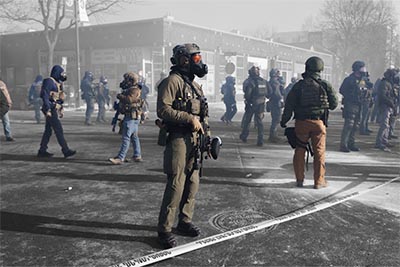
That, of course, sets a tone for the discussion that follows. Photos or stories you will NOT see included or referenced by Tangle include these:
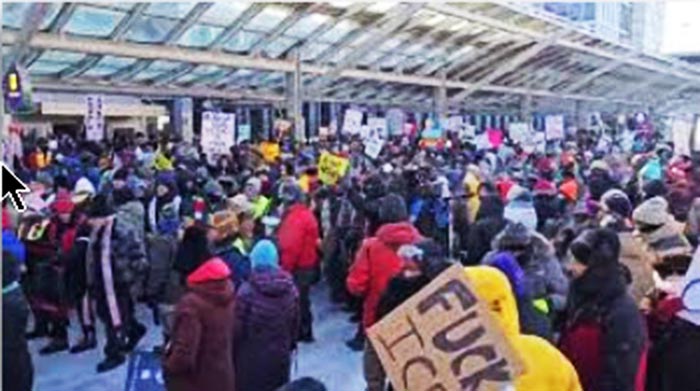
Protesters
march at the MSP airport
and disrupt business activities at
thirteen Twin Cities Target stores.
Note that protesters do not have a right to block building entrances, interfere with customers or
employees, or otherwise obstruct a business's operations, even if they are nonviolent and on nearby
property.
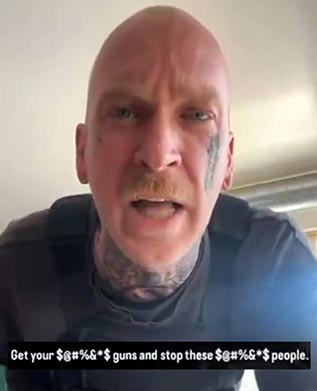
Antifa member urges citizens to take action — "It's time to suit up. Boots on the ground. We're not talking about peaceful protest anymore. Get your f*cking guns and STOP these f*cking people!"
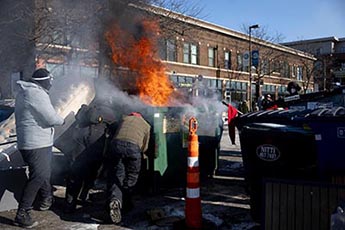
Protesters block traffic, check license plates , demand IDs, set up barricades in the streets, and light dumpster fires at 26th and Nicollet Ave. S.

Alex Pretti confronts ICE agents and kicks out taillights of ICE vehicles just days before he is killed during a 2nd confrontation.

Teachers take elementary kids out of school to march in subzero weather, not the least bit concerned about possible interactions with violent protesters, fireworks, tear gas and ICE agents.
This sort of violence, lawlessness, disregard for and disrespect of the law is not discussed on Tangle, or
in most of the mainstream media. We don't expect the New York Times, Bloomberg, the Wall Street Journal or
the National Review to dig deep, to investigate and report the truth which might help our nation understand
what is really happening during "Operation Metro Surge" and why. But I had hoped that Tangle might make a
little effort to go beneath the headlines.
And I cannot state that Tangle fails completely in its mission to present issues from both the left and the
right, followed by Isaac Saul's "My Take", where he attempts to find common ground midway between the two
extremes. It's what appealed so much to me about Tangle right from the start. But I've come to realize that
posting excerpts from select publications on both sides of the aisle is NOT serious journalism and simply
analyzing those excerpts with commentary is of little value when your original sources are shallow,
incomplete, biased, and often politically and financially motivated.

"We are a team of independent journalists with a mission of reporting stories that go untold by our state's mainstream media. Our dedication to uncovering the truth is persistent and unwavering. Diverging from traditional media, we delve deeper into matters of local significance that are often overlooked in the headlines. If you have a story idea worth sharing, please don't hesitate to email us. We value your input and strive to bring the stories that matter most to our community."

Another excellent source of regional news, information and commentary is posted on the Facebook page of Brittany M. Hughes with 690,000 followers, who is the Managing Editor of MRC Video and host of The Brittany Hughes Show podcast and MRCTV's Reality Check. These are serious, legitimate sources of regional news, but Tangle relies on legacy media and cannot be bothered to seek out in-depth news and information from flyover country.