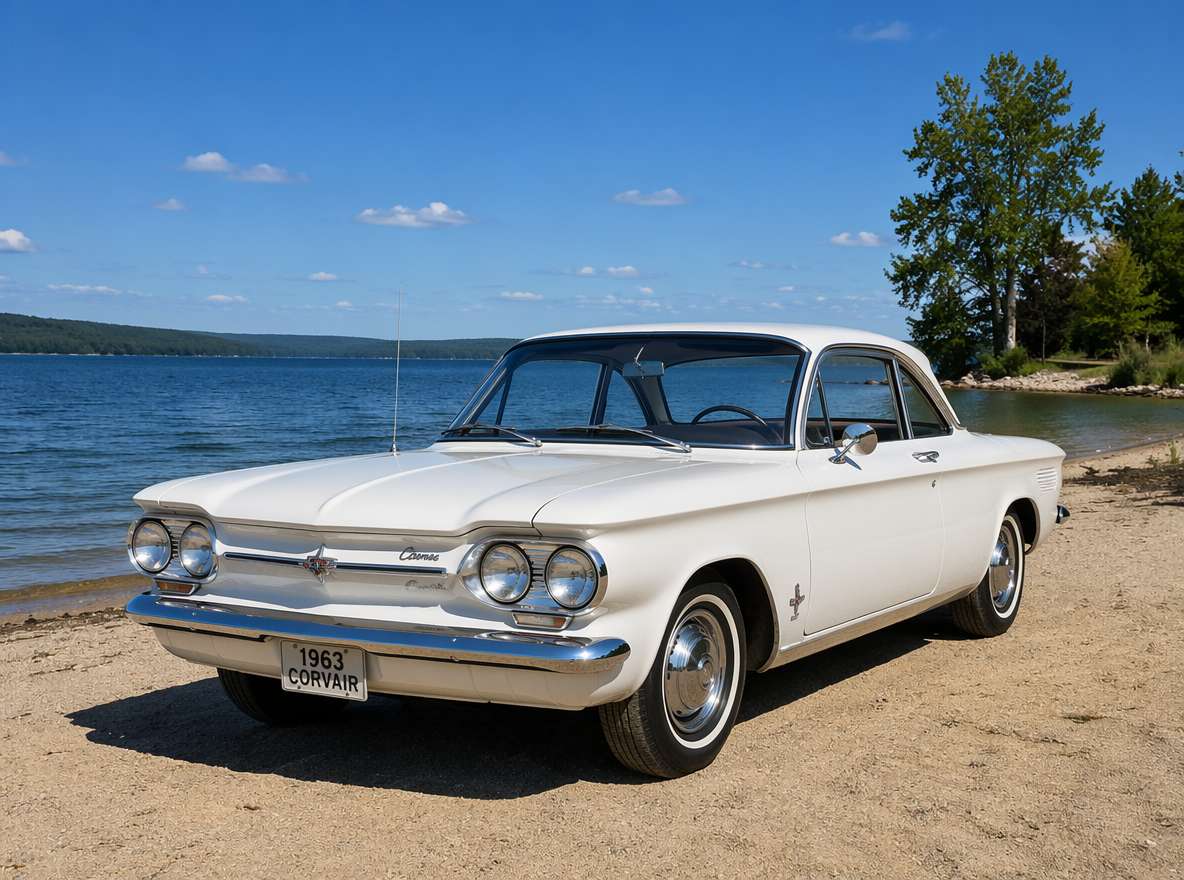
The year was 1966. I was a sophomore at Kennedy Senior High School in Bloomington, Minnesota, driving around in a used 1963 Corvair I had purchased for sixty-five dollars that looked something like this, only not nearly as nice. When I needed new tires, I bought used replacements from a nearby service station where gas cost thirty-one cents a gallon. I listened to music through the crappy AM radio with single speaker that came standard in an automobile of that price — and I didn't care, because the music coming out of that one small speaker was some of the best music ever made.
My father had given me piano lessons on a beat-up old upright, and I had a good ear, but not much patience for practicing. I'd work out popular songs by ear, and I played trumpet in the high school band — making it to first chair, though I'll confess that had as much to do with the guys below me as with my own ability. My senior year, a popular local band called The Caretakers invited me to play Wurlitzer piano, and I picked up alto saxophone for them too. That was the beginning of fifty-five years on stage.
We played the AM radio hits of the day — R&B like "Heat Wave" and "Knock on Wood," Beatles, Rolling Stones, Young Rascals — and naturally we played the Beach Boys. "Surfin' Safari," "409," "Surfin' USA." Their arrangements kept getting more sophisticated with every release, and then came the British wave: the Beatles, the Dave Clark Five, the Animals, Herman's Hermits, Freddie and the Dreamers, Gerry and the Pacemakers — a wall of British sound that swamped everything. But the Beach Boys were the American band that punched back. "I Get Around" knocked the British off the #1 spot in mid-1964, and they just kept coming: "California Girls," "Do Ya Wanna Dance," "Help Me Rhonda." Every new release was better than the last.
I couldn't afford many albums in those days, so the deeper sophistication of Pet Sounds largely passed me by. But when "Good Vibrations" came out in October of 1966, I knew something extraordinary had happened. Brian Wilson had built that one song over roughly seven months, working in four different studios, creating about ninety hours of tape at a cost of more than fifty thousand dollars — reportedly the most expensive single ever recorded at that point. He called it his "pocket symphony." It went to #1 in the US and UK, and the Beach Boys were voted top group in the world in the UK's NME poll, over the Beatles themselves.
After that, I expected the music to keep climbing. Instead, it seemed to stop. The releases that followed never reached that level — at least not the ones that made it to my radio — and I gradually stopped paying attention. The Beach Boys fell off my musical radar for many years. I never understood why Brian Wilson had apparently stopped doing what he did better than anyone alive.
What I didn't know — what I couldn't have known from the outside — was that Brian had actually spent the year before "Good Vibrations" crafting an entirely separate album, working with the legendary session musicians known as the Wrecking Crew while the rest of the Beach Boys were out on the road. That album was Pet Sounds — and it was already finished and in stores when "Good Vibrations" dropped. Brian had been operating a full album ahead of where the public thought he was. And the project that came after Good Vibrations — the one I had been waiting for without knowing its name — had already begun.
In the summer of 1966, Brian Wilson met a 23-year-old session musician and wordsmith named Van Dyke Parks. Brian asked him to write lyrics for the new project — then called Dumb Angel, soon renamed SMiLE. Brian's stated ambition, as he told journalist Jules Siegel at the time: a "teenage symphony to God."
The method was unlike anything in pop music before or since. Instead of recording songs straight through, Brian recorded short interchangeable modules — sections of feel, texture, and key — in different studios chosen specifically for their sonic personalities: Gold Star, Western, Sunset Sound, Columbia. These pieces would be assembled afterward like film editing, with razor blades and tape. Nobody in popular music had worked this way. It anticipates sampling and digital editing by decades.
The concept was sweeping: an American answer to the British Invasion — a suite crossing the continent from Plymouth Rock westward to Hawaii, touching American history, folk mythology, and humor as a spiritual force. At its center: a four-part suite called The Elements — Earth, Air, Fire, and Water.
I heard rumors about this album at the time and was eager for it to arrive. Instead, in May of 1967, it was quietly shelved — pulled back into the dark for reasons that have been written about extensively by others and that I won't dwell on here. What reached us instead was Smiley Smile, a hastily recorded shadow of what had been planned. Carl Wilson later called it "a bunt instead of a grand slam." That description always stuck with me, because it was exactly how it felt.
Life went on. My career took off after graduation — I was hired into a four-piece group that took me to Panama City for a year, then brought me back to the Midwest to begin what became fifty-five years of performing with a variety of groups. The Beach Boys' early catalog stayed in our sets, always crowd-pleasing, always reliable. In the mid-1980s, a band I helped form built an entire costumed Beach Boys theme show — a full hour of their music, with props and costumes — that became our most popular set. I eventually left to form Bob & the Beachcombers, and then the one-man family show, Bob the Beachcomber. For decades, Brian Wilson's music paid my rent.
In 1988, I felt a surge of hope when "Kokomo" appeared in the film Cocktail and went to #1. This was the comeback I'd been waiting for — only to learn that Brian Wilson hadn't written it. It was a pleasant enough song, but it wasn't what I was hoping to hear. So I kept waiting, through a long string of troubled years in Brian's life that have been documented by much more qualified writers than me.
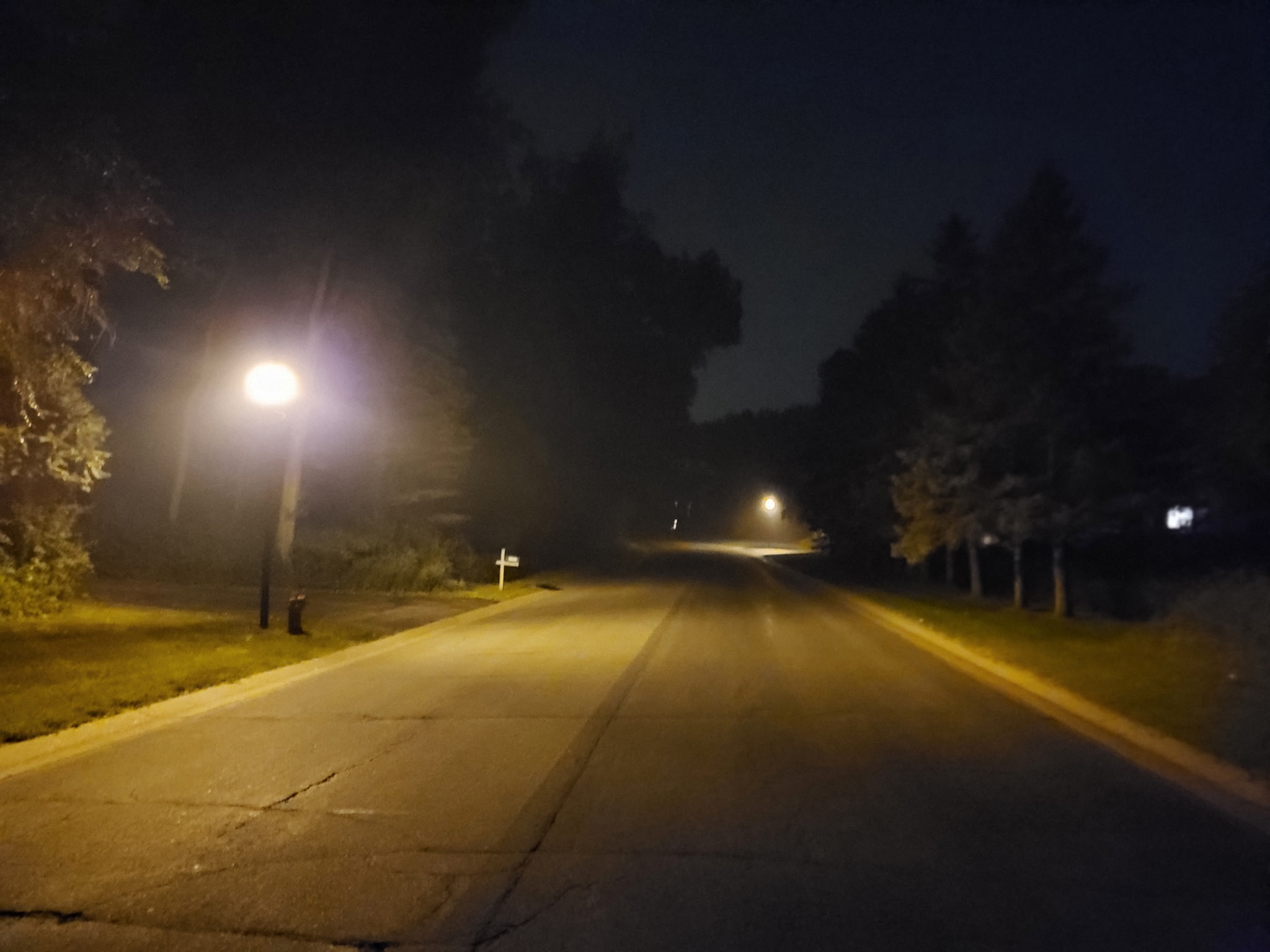
I wrote most of this article on a warm July night in 2026, walking my neighborhood under a smoky haze from distant Minnesota forest fires, the air smelling of campfire. I had been listening to SMiLE on the drive home from a morning show — an hour and a half on the highway, the album filling the car — and I couldn't stop thinking about it. Something had clicked that I hadn't heard before, or hadn't been ready to hear.
What had rekindled all of this was a new book — All Summer Long, released in 2026 — featuring in-depth interviews with virtually everyone connected to the Beach Boys universe: Brian himself, band members, producers, label executives, the Wrecking Crew, Van Dyke Parks, and many others. I cannot recommend it highly enough to anyone who loves this music. My full review is here. Reading it, I realized how much I had never known — and one of the things I hadn't known was how close SMiLE had actually come to existing in 1967, and how different the musical landscape of the next fifty years might have been if it had.
And then I started listening. Really listening.
The intended follow-up single to "Good Vibrations" was "Heroes and Villains" — a Western-mythology epic in miniature, dozens of sections and variants recorded and reassembled. When I first heard it in 1967, I respected it. The instrumentation was remarkable, the vocal stacking extraordinary. But as a pop music guy — someone who has studied, performed, and loved this music for a professional lifetime — I'll be honest: it wasn't "Good Vibrations." It didn't have the same immediate pull. I appreciated it more than I loved it.
Fifty years later, I love it.
What changed wasn't the song. What changed was me — and what I was listening for. As a performer who has spent decades trying to reproduce Beach Boys harmonies on stage, I now hear "Heroes and Villains" the way a carpenter hears a cathedral: not just as music, but as a structure, and a staggering one. The voices are doing three completely different things simultaneously. The bass line is arguing with the lyric. The arrangement breathes and lurches and soars in ways that shouldn't work and somehow always do.
I was curious enough to purchase the full 23-page orchestral transcription of the song, arranged by Thatcher Woodhouse. Six measures tell the whole story:
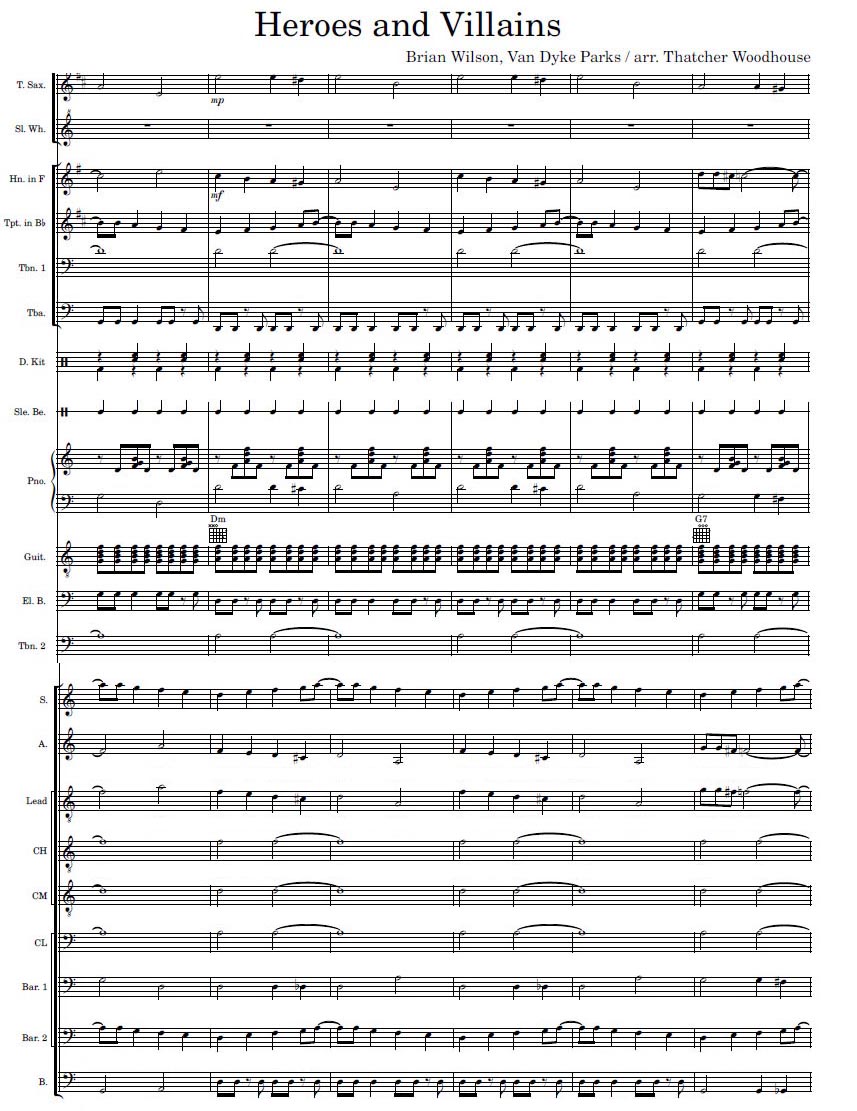
Six measures of twenty-three pages. Lyric text has been omitted from this excerpt out of respect for the songwriters and their publishers.
Count the staves: tenor sax, slide whistle, horn in F, trumpet, two trombones, tuba, drum kit, sleigh bells, piano, guitar, electric bass — and then nine vocal parts running three different melodic streams simultaneously. A slide whistle and a tuba on the same page. Sleigh bells next to a horn chart. Twenty-two staves of notation for six measures of what AM radio called a pop song. Brian Wilson carried all of this around in his head — and recorded it with razor blades and tape, before computers, before digital editing, before any of the tools we now consider basic. I've been a professional musician for fifty-five years. I still can't entirely explain how he did it.
Score: Heroes and Villains, Brian Wilson / Van Dyke Parks, arr. Thatcher Woodhouse. This excerpt is shown for commentary; the complete 23-page arrangement is available for purchase at MuseScore.com — support the arranger.
For thirty-seven years, SMiLE was "the greatest album never made" — bootlegged, mythologized, a ghost haunting every serious Beach Boys discussion. About thirty minutes of fragments surfaced officially on the 1993 Good Vibrations box set. And then, in 2003, something remarkable happened: Brian Wilson, with his touring band and with Van Dyke Parks returning to finish the lyrics they had left incomplete in 1967, decided to finish it.
On February 20, 2004, Brian Wilson Presents SMiLE premiered live at London's Royal Festival Hall. By all accounts from people who were there, it was one of the great redemption nights in the history of popular music — standing ovations, critics weeping, a packed hall on its feet for a man they had collectively given up on decades earlier. The studio album followed that September to overwhelming acclaim.
And then came the coda that still gives me chills: "Mrs. O'Leary's Cow" — the legendary Fire movement, the piece Brian had recorded in 1966 surrounded by smoke and fire helmets and then locked away out of superstitious fear — won him his first Grammy ever. Best Rock Instrumental, 2005 ceremony. The piece he had believed was cursed brought him, at 62, the award that had somehow eluded him through the most creative period in the history of rock and roll.
In 2011, The SMiLE Sessions — the original 1966–67 Beach Boys tapes, finally assembled — was released and won the Grammy for Best Historical Album. Both versions now exist: the 2004 completion and the 1967 ghost, finally audible. The album didn't fail to communicate. It communicated on a thirty-seven-year delay.
The SMiLE album ranges from silly to strange, funny to genuinely sacred in presentation — and that range is exactly the point. Brian Wilson was not making a mood record. He was making an American suite, and America contains multitudes. "Our Prayer" — the wordless a cappella opening — is two minutes of stacked voices that feel like the inside of a cathedral. "Cabin Essence" takes the transcontinental railroad and the Grand Coulee Dam and turns them into something that sounds ancient. "Surf's Up," which Leonard Bernstein featured in a CBS television special in December 1966 as evidence that pop music had become serious art, remains almost unbearably beautiful.
As for the extended version of "Good Vibrations" on the SMiLE album — it is not a replacement for the original. It's something else: the same song seen from a different angle, with extended codas and alternate harmonic choices that reveal how many decisions went into what sounds, on the single, like inevitability. Hearing both versions is like seeing an architectural drawing next to the finished building.
"Brian Wilson is now a state of mind. The body may be gone, but his feelings, his thoughts, are still palpable, still as fresh as when they were committed to wax. And we still can't figure out how he did it."
— Bob Lefsetz, The Lefsetz LetterI have been playing this man's music for fifty-five years. I have stood on stages in Minnesota, Florida, and a hundred rooms in between, trying to reproduce those harmonies with whatever voices I had available. I have watched audiences light up at the opening chord of songs Brian Wilson wrote before most of them were born. And I still, honestly, cannot fully explain where that music came from — or how one man heard it all inside his head and found a way to get it onto tape.
What I can say, from the inside of a career spent performing it: the music works. Night after night, decade after decade, in senior centers and bars and children's theaters and county fairs, it works. That's not a critical judgment. That's fifty-five years of field research.
He gave us good vibrations. We're still picking them up.